Time and Memory
A Conversation with Jackie Craven
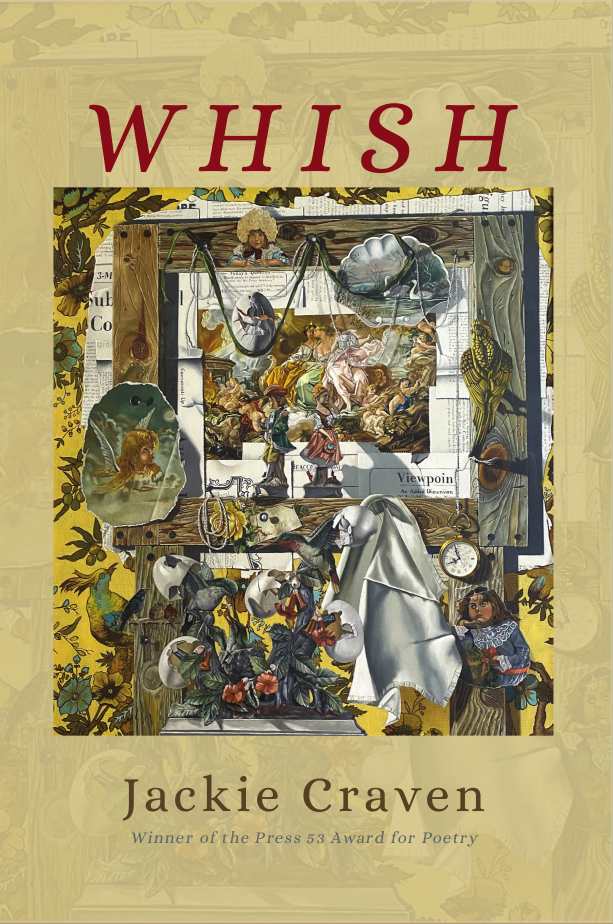
Poet Lore contributor Jackie Craven chats with Editor Emily Holland about her new collection WHISH, the time it took to craft these poems, and the impact of literary journals on her writing and editing process.
Emily Holland: To start, can you talk about the publication process for this book? When did you start writing these poems? And how has it been working with Press 53?
Jackie Craven: Long before I imagined the book, I tried to write about the eerie movement of time, the way it squirms, shape-shifts, tampers with clocks. The earliest poems date back to a library workshop I attended ten years ago, and the newest emerged only weeks before the book went to press. I revised obsessively, not just to strengthen the poems but to mold them to fit the tone and pacing. I submitted various versions under various titles to more presses than I can count. When several contests placed my submission in semi-finalist and finalist pools, I seemed to be getting closer. But even after WHISH won the poetry award at Press 53, the revising continued. Series editor Tom Lombardo met with me over Zoom to discuss the organizational strategy for the collection. I’m overwhelmingly grateful for the attention Tom gave my work and I enthusiastically embraced his suggestions.
As a Poet Lore contributor, and a contributor to other literary journals, what is the impact of a literary journal on your trajectory as a poet?
Without journals, there’d be no book. The inspiration for WHISH began with a single poem that appeared in Ploughshares. Other poems were published in about twenty different outlets. The process of compiling a collection can take years, and journal publication provides much-needed encouragement and validation along the way. More importantly, journals like Poet Lore provide a platform for ongoing conversation about the poem, the craft, and the themes explored. Through Zoom workshops, talks, and readings, I harvested new ideas. The Ploughshares poem evolved into a much longer piece and then became two separate poems for WHISH.
I’m thinking about the two poems that have been featured in recent issues of Poet Lore – “First a Throb of Wings” from a 2019 issue and then more recently “Memory—” in Chet’la Sebree’s folio on Home & Hiraeth. They are two very different poems, but we can still see some similar elements between them – the image movements, the way the poems use subtle repetitions as a match strike for emotional impact… looking back at your work, can you see the through lines of your writing style and voice? How do the poems in WHISH lean into those elements or subvert them?
I was so happy to see these pieces in Poet Lore! Both poems begin with familiar images — telephone wires, a fluorescent T-shirt — and tumble into the absurd. A bird becomes a sexual predator. Memory becomes a lover who might pack the Fourth of July into a U-Haul. Disturbing topics feel more manageable in the world of fantasy and dreams. “First a Throb of Wings” merged with new poems to form a chapbook about a girl made of gears and wires. (Cyborg Sister, Headmistress Press, 2022). In turn, the Cyborg Sister chapbook generated a series of “Human Clock” poems. The Human Clock became a repeating trope in WHISH, where seconds, minutes, and hours turn into living creatures who mess with our lives. Anthropomorphizing time gave me a way to explore themes of dehumanization and betrayal. A dash of humor also helps.
How did you compile this manuscript? When did you know these poems were meant to be together?
Although I had more than enough poems for a full-length collection, I wasn’t at all sure they belonged together. Some of my favorites, like “Memory—”, touched on topics I wanted to explore, but the voice didn’t harmonize with the other poems. Or, when the voice seemed right, the content felt out of place. I shuffled the manuscript on my living room floor, removed many of the poems, and wrote new ones. Still, the puzzle would not come together. Should I move through the manuscript chronologically? Geographically? Thematically? Can prose poems and lineated poems live in the same book? Maybe I should toss the poems to the wind. I took online courses on how to assemble a poetry manuscript. I read Ordering the Storm by Susan Grimm and Marbles on the Floor edited by Sarah Giragosian and Virginia Konchan. In the end, I had two dozen versions of WHISH under several titles. I was still shuffling poems when Press 53 selected the manuscript. My editor, Tom Lombardo, suggested that I eliminate the section divisions and let the poems flow in a rhythmic pattern: Three prose poems followed by a lineated poem, consistently throughout. The weird world I created needed this systematic approach.
What have you learned over the years in the publishing landscape, both with journals and with book publishers?
Patience + Persistence. Most journals and presses require several months to review submissions. I’ve discovered that I also need time. For me, it’s almost always a mistake to submit work immediately after the first rush of creation. On the other hand, it’s all too easy to over-revise, whittling away the spark that inspired the poem. So, after a bit of down-time, I submit, submit, and resubmit. Some of my strongest poems were rejected fifteen or twenty times before finding homes.
Are you working on anything new at the moment?
I’m knee-deep in a collection of prose poems that delve into the relationship between houses and their occupants. Rooms gossip, refrigerators complain, and chairs rebel against their owners. I used to work as a columnist writing about architecture and home design, and these quirky pieces have been rattling at the back of my head for many years.
Do you have any advice for poets just finding their footing in the writing and publishing world?
The long waits and deluge of rejections can be soul-crushing. I think literary journals can become valuable guides through the process. Choose one to follow closely and read each issue in its entirety. Jot observations and comments in the margins or in a notebook. If your chosen journal offers craft talks and courses, participate as much as you are able. After a few issues, you’ll feel like an insider. Repeat the process with another journal and, of course, submit widely and often.
Jackie Craven writes poetry and prose steeped in magical realism. Her new collection, WHISH, won the 2024 Press 53 Award for Poetry. She’s also the author of Secret Formulas & Techniques of the Masters (Brick Road Poetry Press, 2018) and chapbooks from Headmistress Press and Omnidawn. Her poems appear in AGNI, Alaska Quarterly Review, The Cincinnati Review, Pleiades, Ploughshares, Poet Lore, and other journals and anthologies. She lives at JackieCraven.com and on Zoom, where she hosts an open mic for writers.