Poems from Winter/Spring 2026
Emily Holland
/
02 June 2026
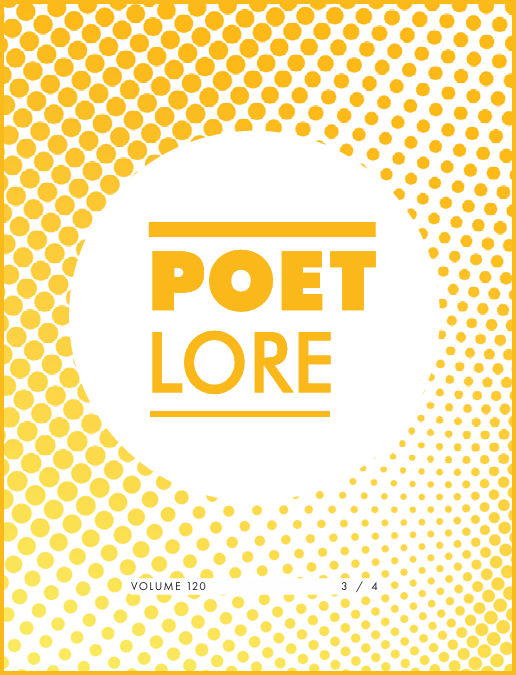
Read 7 poems from Guest Editor Patrycja Humienik’s Guest Edited folio “On Devotion” from our recent print issue
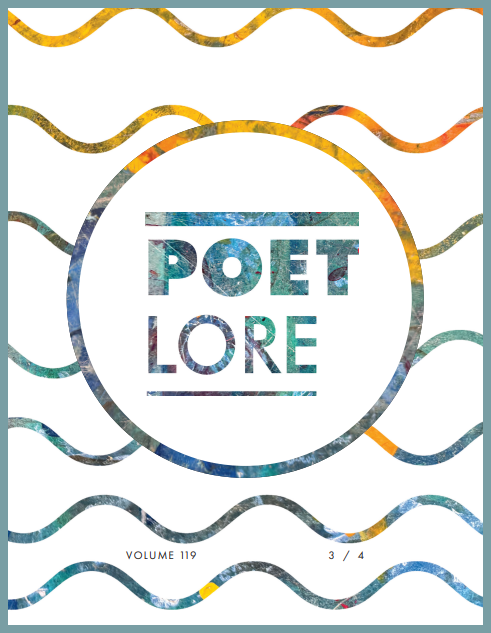
From Patrycja Humienik's folio "On Devotion" in Poet Lore Volume 120 3/4
Jane Huffman

A few notes on a composition by Edmond Jabés

Some words come too close. Limerence,
too close. Like mishearing someone’s name
three times but being too ashamed to ask
a fourth, and so compromising with not
knowing—the line between nearly knowing
and knowing is a deep line—until someone
else within earshot introduces themself.

Earshot, too close. Too close to significance
to be an adequate sign, like the violist who
wears a single earring to accommodate her
viola. No daylight between shoulder, ear.
Lord, if you must make me an instrument—
I once wrote, though I no longer remember
the context, the inference—make me that one.
From Patrycja Humienik's folio "On Devotion" in Poet Lore Volume 120 3/4
Ally Ang

Unsexed, my body upends its tethering

in the darkness, darkness draped
around me like a gown, my outline
mercifully obscured. I once believed

it was worship I craved, would prostrate
myself before any gilded calf whose marble
eyes beheld my image. now, I gnaw

at the hand that heeds me, my nakedness
impenetrable and mundane. is it possible
to fashion a new lexicon for desire

that doesn’t demand my self
-betrayal? to be an unnameable
creature, belonging to no one, governed

only by my want; no signifier to cling to,
groping through the absence towards god
knows what—
From Patrycja Humienik's folio "On Devotion" in Poet Lore Volume 120 3/4
Chaun Ballard

Upon Arriving to the Future Someone Will Tell You

How the horses galloped to the back door.
That there could have been a stall.

They won’t remember all the particulars.
You should know it was not a one-horse town.

But the road was solid dirt. A smudge of houses.
Maybe there was some gravel involved.

There was almost certainly a horse.
At one time or another a bull

but that’s a different story entirely.
The road someone will say

almost certainly for horses was made for horses.
& the man with his horse hauling ice for the icebox.

You were not yet a story then
nor smaller than avocados.

Your grandmother hung clothes on the lines.
Folded bed sheets unassisted.

Your father was a gambler like his father.
Back when all gamblers were bad gamblers. & fathers.

After we lost our tethers in the afterbirth of homes
we prescribed for ourselves another world’s dwelling.

Your grandmother was beautiful.
The way she could keep a house.

Your grandfather lost his father to the land.
It was the way of men to lose things.

To wager all as if tradition.
Collectors were sublime. You should have seen them.

How they mesmerized us.
The way they levitated the doors.
From Patrycja Humienik's folio "On Devotion" in Poet Lore Volume 120  3/4
Aurora Shimshak

Prairie

This night has no house and must live as fragments do
in the corners of our eyes.

If frog sound would hold my hand.
If it would reach for me the way air does

when it gets cool enough to lift
the stone scent from the road.

White Baptisia is the first flower you see, cane of bells against
the cloud-bandaged sun.

On the edge is a house
that ate too much house, lit up like the Disney castle.

This week they put my grandma into memory care.
An extra lock to get to her.

This is how I know the night can’t live anywhere
without being ripped apart. Not even here

where its smallest feathers stick in your throat.
Fireflies come on like they do. First one, then two.

When I talk to god, I try not to sound desperate.
I don't want to let on that I’m greedy for my place

in a cathedral of insects, serene as a cave of absinthe bottles.
I held so long as memory, the physical I first met

on my grandma’s road. I didn’t think I’d walk through it again—
that hatch of light, and bats displacing sky

near my unkissed lips.
I think god is what it meant to me—

everything I figured out so far that god is:
being saved, being witnessed as your strong self
by an eye that’s bare and infinite, an eye that’s you
and knowable only in patches.

Tried to write about it so many times.
Called it peach hour.

Tried to write it without saying god.
From Patrycja Humienik's folio "On Devotion" in Poet Lore Volume 120 3/4
Lue Hughes

Good Girl

          “Your mother passes away and you become an asshole?”
          —Evelyn Lozada, Basketball Wives, season 8, episode 2

The white wooden cross glued to the hairless
red alder tree on our drive to Yakima, I hate it.
There are Bewick’s Wrens whisking the field
in front of irrigation pivots, an overgrown fir tree
splayed open like a man with his legs up begging
to be entered. My husband admits it’s his first time
being this close to a mountain and the snow lazily
slapped across its face annoys me. In the stretch of farmland
next to the freeway sign that announces Selah is four miles away,
a large swatch of horses graze. The city name, Selah,
sounds like a prayer. Selah to the horses my mother loved.
Selah to the army truck hauling its dead friend home.
Selah to the ugly patches of dried moss grass mountainside.
Selah to my husband whose mother is next in line to die.
Selah. Selah. Frank Ocean whispers through the rental car speakers—
I’m glad he’ll never return to music. Selah. On a hilltop
in the distance, a lonely farmhouse pierces the ruddy blue sky.
In the movie, God’s Own Country, Johnny gets topped
by Gheorghe in the mud outside his father’s barn,
I’m reminded watching the house disappear as we knife
into another hill. If he asked, I’d let my husband love me
into Earth’s grime as the cows watched, but he’s too green
in the mouth. Most times when anger pebbles inside my body,
the only medicine needed is a good plow. I want to be told, Good girl.
I want the truck with the garland of logs to switch lanes.
I want a Coke and McDonald’s fries, “Snooze” by SZA playing
in the background. I want my mother resurrected
as the real Jesus. Who decided a man would be our Savior?
Selah. When was the last time a man saved anyone?
From Patrycja Humienik's folio "On Devotion" in Poet Lore Volume 120 3/4
Malvika Jolly

Suddenly It Was November

And I was falling in love. I heard myself in a new language where I had known all the nouns since childhood, and none of the verbs. It rained every weekend as it had for many years in the city. Ever since the climate shifted, collapsed, and recohered. Said wrote of crisis that it gave shape to plot, was felt during dreaming as the encroaching arrival over the horizon of narrative time. Outside, the white hydrangeas in the night wind. Inside on the stove, the water smoking without boiling. It was summer in the rooftop apartment. Winter on the street below. I waited eagerly for you to reach my swollen door. A single bedsheet. Stack of novels and an unmoored mattress. From a distance, a single speck of light. Receding line of plot. Marx said of species-being something I had already forgotten, or never learned to begin with. I was watching the same three honeybees come and go daily from my rooftop apartment—a kind of rental property, in Hindi, named after solitary nights of summer rain. I made espresso and poured it over the lemon blossoms. I wandered through the house of a poem. I wondered would such rooms exist past the premise of flood? Meanwhile, I began practicing the mechanism of unlocking my own heart—in truth, a sandalwood box used to house caraway and fennel seeds—guarded nightly by a delicate brass clasp. I began striking blue matchsticks as an oracle. Dangling spoons above my belly and seeing which way they fell. Entering packed elevators with your face in my palm. When I copied books for my students, you watched me from my phone, propped up within the basin of the scanner. In fact, we were there together beneath its makeshift tin roof, raised and rattling, soon collapsing, under the weight of a watery sky, the way ortolans are most fragrant from beneath the cloth or women travel without realizing beneath the shadow of a red bridal veil, the way two strangers lower their eyes beneath the same umbrella, and even the umbrella only a euphemism for when what comes next comes next.
From Patrycja Humienik's folio "On Devotion" in Poet Lore Volume 120 3/4
Alberto Álvaro Ríos

The Day I Wrote 'All' in Cursive

I was six, maybe seven.
Second grade. Miss Lee’s class.

We were learning cursive—
A kind of magic we were expected to master.

The paper had hypnotic green lines:
One solid at the top, one at the bottom,

One dashed across the middle
Like monkey bars the letters had to cross.

It looked like music.
It felt like music.

We practiced loops. So many O’s.
If they’d formed a circle themselves,

Zinnias would have appeared.
We practiced holding the pencil right.

Then one day, right before 1960,
I wrote the word all.

Just that—three letters.
But perfect.

Even the a behaved.
Even the l stood up straight.

Miss Lee looked at it.
She smiled in a way that said she saw it too.

She let me take it home,
As if it were something special.

And it was.
I knew it.

It felt like unlocking a door
I hadn’t even known was closed.

I showed it to my mother,
Then put it quietly away.

That paper spoke out to me for weeks.
Maybe longer.

I still remember the lines.
Still remember how all looked bigger than it was.

Because it did.
And maybe still does.